
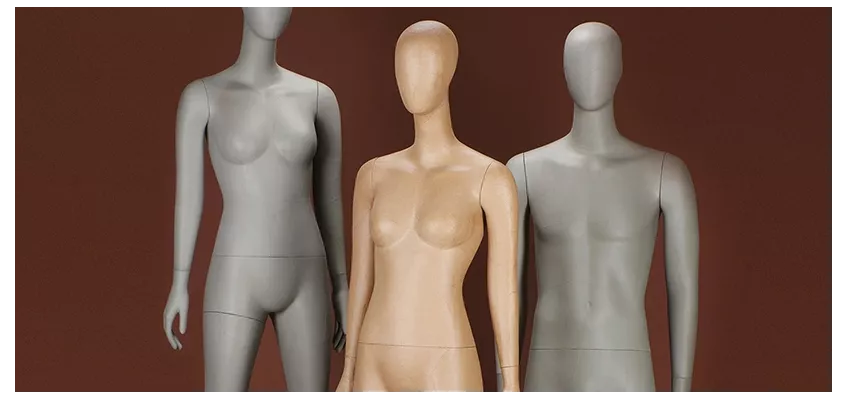
Why is ecology so important to us? Mannequins caring for the environment.
Art lovers who can appreciate the aesthetic values of human creations will undoubtedly agree with the statement that Mother Nature is the most outstanding artist. However, the beauty of the surrounding nature will not be eternal if we, as humanity, do not take decisive action to protect the environment. For MORE Mannequins, this is a particularly significant issue, which is why we have prepared three new mannequin production technologies that will contribute to the implementation of our ecological development strategy!
Sustainable Development Strategy - Caring for Our Planet
"Changes should start with ourselves and our surroundings," explains Konrad Szafirowski, the founder of MORE Mannequins, and the reason behind why our company is implementing an advanced sustainable development strategy. The goal of our action plan for the years 2019 - 2023 is to implement significant changes in environmental protection and is based on five pillars:
● Eco Office
● ZERO PLASTIC Packaging
● ECO Materials
● LEASE & REUSE
● RECYCLING of Mannequins
We have already implemented most of the planned solutions. In our office, we use a photovoltaic installation and a heat pump. As pioneers in the industry, we have developed a durable packaging for mannequins without using foil or other non-biodegradable materials. We offer our customers a groundbreaking model of long-term mannequin rental, which allows for their use by multiple owners. For us, ecology is not just a slogan, but a real value around which we build our company.
Three New Materials We Use for Production! Ecological Innovation
However, the core of our efforts towards environmental protection lies in the production of mannequins that do not pollute the environment. A few months ago, we started working on new materials that we could use for this purpose. The result of our efforts is three new proposals for raw materials that we will use in the production process. As Konrad Szafirowski explains, these are solutions that are not only more environmentally friendly but also of higher quality.
The three new mannequin production technologies are:
● PET bottle and corn - using recycled PET bottles that, after processing, will be used as fibers and materials, along with biodegradable resin made from corn.
● Paper and rice - the technology is based on using rice paper, glue made from rice flour, providing the product with above-average strength. The mannequin consists of up to eight layers of paper, which are bonded with rice glue. The outer coating can be made of paper or covered with traditional lacquer. What is the difference? If the outer coating is made of paper, customers will notice the technology, which is particularly important for companies emphasising environmental care in their communication. Covering the final layer with traditional lacquer will not impact the environmental friendliness of the product, but the applied technology will not be visible to viewers.
● Paper and corn - in this case, we also use rice paper, and it is possible to coat the final layer with lacquer or leave it uncovered. The technology differs from "Paper and rice" in terms of materials - we use biodegradable corn resin and traditional paper.
What else distinguishes these technologies besides the materials used? MORE Mannequins founder Konrad Szafirowski explains: "Although the functions of these three solutions are identical, much depends on the order quantity. We choose the most convenient technology based on the number of mannequins to be made - several dozen or perhaps several hundred. The purpose of the mannequins is also essential, so we offer the best option to customers after a discussion of their needs."
Depending on the applied technology, the mannequins also have different parameters - they can be lighter or heavier and slightly differ in appearance (if used as outer paper layers without lacquer coating, as described in the case of Paper and rice, Paper and corn).
What solutions have we used (and continue to use) in mannequin production?
As alternative solutions to innovative technologies, there are more traditional ones, such as using ABS or PE material. Products made from these materials are also environmentally friendly, as they function within the circular economy. However, they are not as efficient at low quantities as our proprietary solutions. Therefore, the PET bottle and corn, Paper and rice, and Paper and corn technologies are definitely more environmentally friendly and advantageous for customers who value the highest quality.
As Konrad Szafirowski explains, quality is the most important aspect for MORE Mannequins - "I often tell my customers that it is better to buy fewer mannequins made from better materials than to focus solely on quantity. Products of inferior quality are more prone to wear and tear, which will lead to their quick replacement. Such action is neither environmentally friendly nor economically beneficial for the customer."
Ecology - that is what the world needs!
Why do we at MORE Mannequins decide to introduce new and environmentally friendly production methods? We do this in the interest of the environment. One of the most commonly used materials in the industry is Fibreglass Reinforced Polymer (FRP). Unfortunately, when producing mannequins using this method, silicon, fiberglass mat, and polyester resin are used, which is very toxic. These materials are not fully recyclable, making complete reusability impossible.
"The carbon footprint in the production of a mannequin made using the Paper and rice technology is even 90% lower than with FRP. With Paper and rice, we use recycled paper, and the entire product is made entirely from natural materials. This allows the used mannequin to be returned as wastepaper and this material to be reused to produce paper or cardboard. In the case of PET bottle and corn and Paper and corn technologies, the used mannequin can be ground into flour and used for the production of construction materials, such as bricks. These examples illustrate how environmentally friendly the use of mannequins made from biodegradable materials is," says Konrad Szafirowski, adding: "This is particularly important for companies in the clothing industry, which share similar values as MORE Mannequins. To maintain consistency in their environmental protection efforts, they often choose our products. They know that the quality of the mannequins affects not only their durability and aesthetic value but also the environment."
MORE Mannequins - Innovation in Service of the Environment
The founder of MORE Mannequins proudly emphasises that we are one of the first companies on the market to implement such solutions. Innovation and the desire to find the best solutions result primarily from our attention to detail and the pursuit of perfection. In the art of creating mannequins, the most crucial aspect is to combine functionality with aesthetic qualities. We have added the ecological aspect to this, making our products not only visually appealing and of high quality but also environmentally friendly. An environment that each of us should take care of, because only in this way can we ensure that our planet remains a friendly home for us all.